AI in Recruitment
Ireland’s IT skills gap: why the answer is better training, not blaming Indian workers
Tauseef Sarwar••6 min read

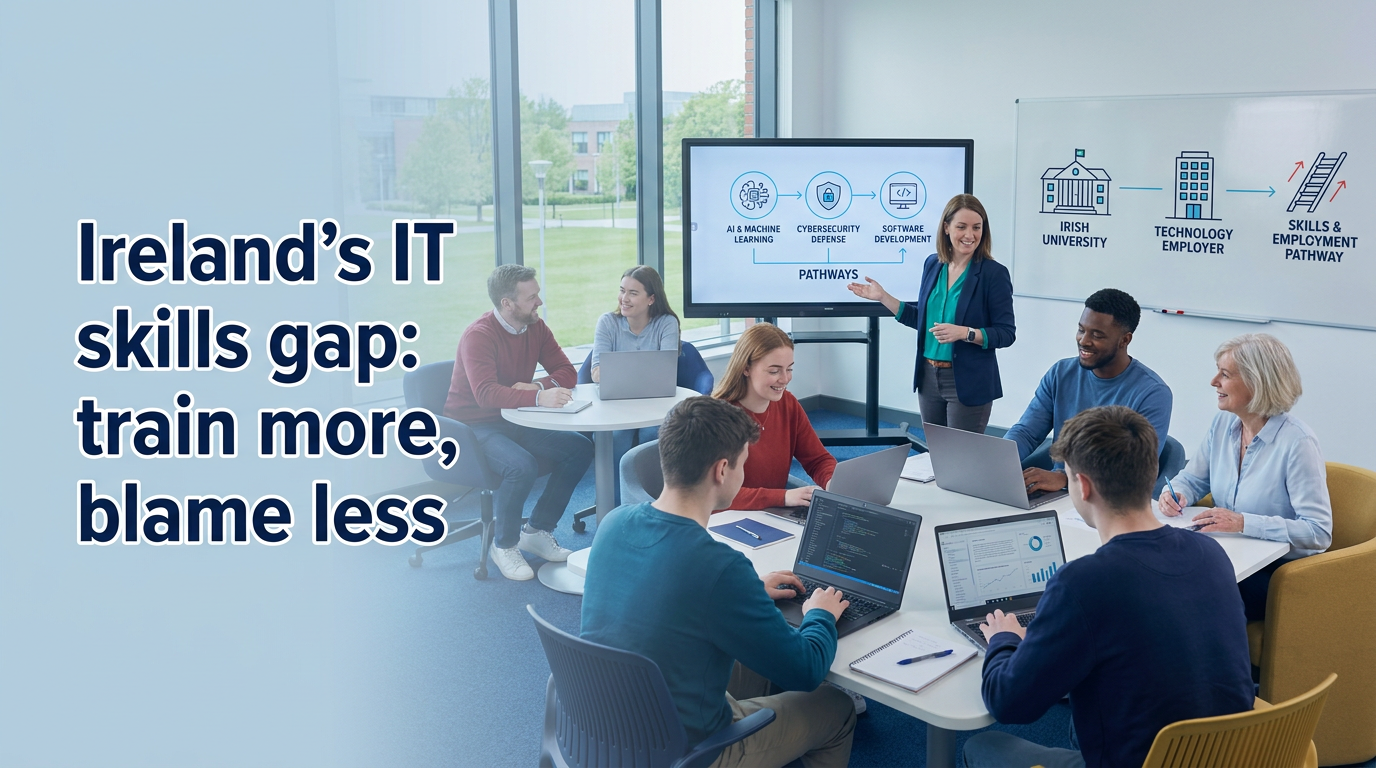
Ireland relies on international technology workers while many residents struggle to find a clear route into IT and AI careers. The solution is a stronger education-to-employment pipeline, better employer accountability, and targeted investment in local skills.
Ireland has a technology skills problem.
The country attracts global technology companies, offers tax and investment incentives to multinationals, and issues employment permits to people with skills that employers say they cannot find locally. At the same time, Irish graduates and career changers often say they cannot find a clear route into IT, software, cybersecurity, data, or artificial intelligence.
**That combination creates frustration.**
Some people see Indian technology professionals arriving in Ireland and conclude that they are taking jobs from Irish workers. That conclusion points anger in the wrong direction. Indian professionals are using a legal employment-permit system to fill roles employers have identified as difficult to recruit for. The deeper question is why Ireland has not built a large enough, well-funded pipeline of local workers for the skills its economy needs.
**What do the numbers show?** The frequently repeated claim that Irish companies are hiring “500 Indian IT professionals every month” needs to be treated carefully. I could not find an official source confirming that specific monthly figure for IT workers.
Official data does show significant international recruitment. In 2024, Ireland issued 38,189 employment permits. More than 6,500 permits were granted to professionals working in ICT, according to the Department of Enterprise, Tourism and Employment. India was the largest nationality group, with 13,147 permits issued across all sectors. The Department’s official figures are available here.
The figures also need context. Indian permit holders are not all IT workers. Many employment permits are issued in healthcare, hospitality, agriculture, and other sectors. A nationality figure cannot be converted into a technology-job figure without more detailed data.
The European Commission’s 2026 Digital Decade report nevertheless identifies a real structural issue: Ireland’s growth in ICT specialists is too slow, and shortages in advanced digital skills are constraining technology adoption and productivity. The Commission recommends strengthening the ICT pipeline and aligning education and training more closely with employer demand. European Commission report.
The problem is real. Blaming people who were recruited under the rules is not a solution.
**Why are employers recruiting internationally?** Ireland’s multinational technology sector has expanded faster than the domestic education system can always respond. Employers need people with experience in software engineering, cloud infrastructure, cybersecurity, data engineering, artificial intelligence, DevOps, and technical project management.
Some roles require several years of experience. Others require specialist knowledge that is not widely available among recent graduates.
International recruitment can fill those gaps quickly. It can also help companies continue operating in Ireland when a vacancy remains open for months.
But international recruitment becomes controversial when local workers see job advertisements requiring experience they have no realistic way to obtain, while companies receive public support and tax advantages. The result is a perception that Ireland welcomes multinational investment but leaves Irish students to navigate the skills gap alone.
That perception should be taken seriously, even when the explanation is more complex than “foreign workers are taking Irish jobs”.
Is Ireland offering enough AI education? Ireland does offer AI and computing courses. Universities, technological universities, Skillnet Ireland, Springboard+, and private providers all contribute to the skills system.
**The problem is scale, access, and alignment.**
A full postgraduate degree may be too expensive or impractical for a worker who needs to reskill while supporting a family. A short course may provide useful knowledge but not enough industry experience to secure a first job. A traditional computer science degree may not cover the tools and practices employers are using three years later.
The Government’s 2026 Digital Ireland skills plan recognises these challenges. It proposes a National Skills Observatory, an online AI skilling platform, a nationwide digital and AI campaign, and continued digital transformation of tertiary education. The Government’s skills plan sets out the direction.
The issue is whether these promises become visible pathways for ordinary students and workers.
What should Government do? 1.** Link multinational incentives to local training** Ireland should not abandon foreign direct investment. Multinational companies provide employment, exports, tax revenue, research, and connections to global markets.
However, public incentives should come with stronger skills obligations. Companies receiving significant State support should be expected to contribute to Ireland’s talent pipeline through:
- Paid graduate programmes. - Structured technology apprenticeships. - Industry placements for students. - Mentoring in secondary schools and technological universities. - Shared training labs and cloud-computing access. - Funding for conversion courses in cybersecurity, AI, data, and software engineering. - The objective should not be to reserve jobs for Irish citizens. It should be to ensure that companies benefiting from Ireland’s business environment also help develop the workforce they need.
2. **Create a national IT skills guarantee** Every eligible adult should have access to a funded pathway into a recognised digital role, with clear information about the expected time, cost, curriculum, and employment outcomes.
The guarantee could focus on areas identified by employers and public bodies:
1. Cybersecurity operations. 2. Cloud engineering. 3. Data analytics. 4. Software testing. 5. AI model deployment. 6. Data governance. 7. Digital project management. 8. Technical support and network administration. 9. Courses should include practical projects, not only lectures. Employers should help design assessments and offer interviews to successful participants.
3. **Expand paid conversion routes, not only postgraduate degrees** Ireland needs more than a small number of elite AI postgraduate programmes. It needs flexible routes for people who already have degrees, work experience, or strong technical ability.
A graduate in mathematics, physics, business, languages, or engineering may be capable of moving into technology with the right training. So may a worker in administration, manufacturing, finance, or customer operations.
Government funding should support modular learning that can be completed part-time, with credits that build towards a larger qualification.
4. **Make work permits more transparent** Employment permits exist to address skills and labour shortages. The system should publish more detailed information about permits by occupation, sector, salary level, region, and nationality.
That would help the public understand where shortages genuinely exist and where companies may be using international recruitment for cost or convenience.
The Government already states that employment permits are not intended as a long-term substitute for upskilling Ireland’s resident workforce. Government permit policy should be matched by regular public reporting on what employers are doing to train local workers.
5.** Improve the transition from education to work** Many students complete technology courses but still lack commercial experience. Employers then ask for experience that graduates cannot obtain without being hired.
Government can help break that cycle by funding paid placements, public-sector technology projects, supervised apprenticeships, and graduate roles in SMEs.
Ireland’s public services could become a major training ground. Local authorities, hospitals, schools, transport agencies, and public bodies need cybersecurity, data, software, and AI skills. Properly supervised graduate programmes could create value for the State while giving workers credible experience.
6. **Protect fairness without scapegoating migrants** Irish workers have a legitimate right to ask whether the labour market is working fairly. They should be able to question salary levels, recruitment practices, permit rules, outsourcing, and the quality of training provided by employers.
That conversation should focus on employers and policy, not on the nationality of colleagues.
Indian IT professionals are not responsible for Ireland’s shortage of AI courses, weak graduate pathways, or the failure to link multinational incentives to skills development. They are individuals working, paying taxes, and building careers.
**The real choice** Ireland can continue to treat international recruitment as the easiest answer to every technology shortage. Or it can use that recruitment as a bridge while building a stronger domestic skills pipeline.
The answer is not to close the door to talented people from India or elsewhere. That would damage employers, public services, and Ireland’s international reputation.
The answer is to make sure Irish students and residents have a fair, affordable, and visible path into the same future.
That means linking multinational support to local training, expanding practical AI education, publishing better permit data, and giving adults a realistic way to reskill.
Ireland’s technology strategy should not be “foreign workers or Irish workers”.
It should be international talent plus a stronger Irish talent pipeline.
#IrelandTech #AISkills #FutureOfWork
AI disclosure: This article was researched and drafted with AI assistance, then reviewed and edited for accuracy and clarity by the AIMarketer editorial team.
Author tools
Join the discussion
Add a thoughtful response or a question. Every contribution is reviewed before publication.
Be the first to start the conversation.
AI in Recruitment
AI in Recruitment