
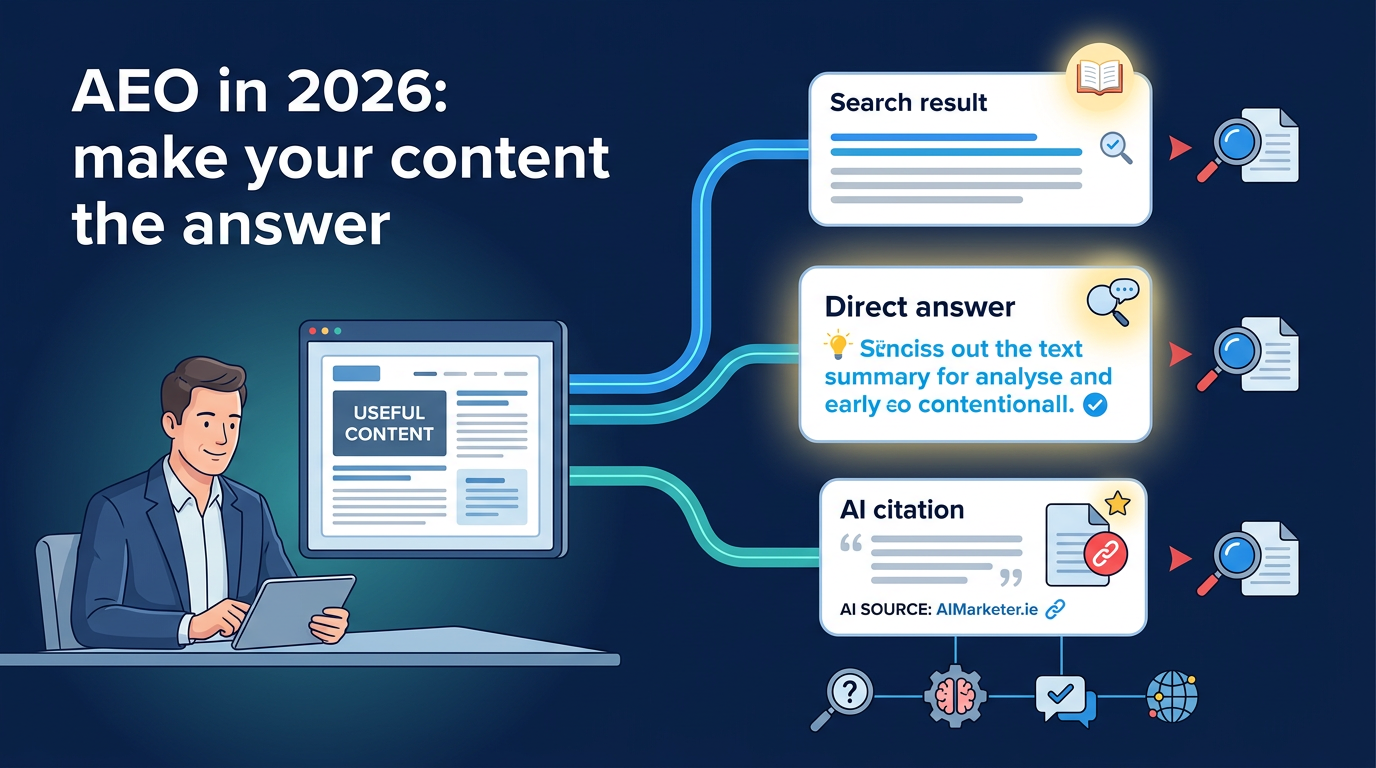
Answer Engine Optimisation is changing how businesses think about search visibility. Learn what AEO means, how it differs from SEO and GEO, and which practical techniques are supported by current search guidance.
What if your best-performing search result is no longer the page people click?
In 2026, Google, Bing, ChatGPT, Perplexity, and other answer-led systems can summarise information before a user visits a website. Your content may still influence the answer, but the visitor may see your brand as a citation, a recommendation, or a short explanation inside someone else’s interface.
That is why marketers are talking about Answer Engine Optimisation, or AEO.
The term sounds like a replacement for search engine optimisation. It is not. AEO is better understood as an additional layer of SEO, designed for search experiences that answer questions directly rather than simply presenting a list of links.
The practical goal is simple: make the useful part of your content easy to find, understand, verify, and reuse.
**What is Answer Engine Optimisation?** Answer Engine Optimisation is the practice of structuring and improving content so that search systems can use it as a direct answer to a user’s question.
*That may include:*
- A featured snippet. - A “People also ask” response. - A voice-assistant answer. - A Google AI Overview. - A response in Google AI Mode. - A citation in Microsoft Copilot. - A recommendation or explanation from an AI assistant.
AEO is not about making every page short. It is about making the answer clear.
A detailed article can still perform well if a search system can identify the relevant passage and understand the evidence behind it. A short page can fail if it avoids the question, uses vague language, or leaves important claims unexplained.
**A useful section often follows this pattern:**
**Question: What is AEO?**
Direct answer: AEO is the practice of making content easy for search and AI systems to understand, extract, and use when answering a user’s question.
Explanation: The rest of the section defines the term, gives examples, explains its limits, and links to reliable sources.
That structure helps both readers and machines.
**How is AEO different from SEO and GEO?**
The three terms overlap, but they describe different goals.
SEO, or Search Engine Optimisation, focuses on helping pages appear prominently in traditional search results. It includes technical accessibility, relevant content, internal links, page experience, and authority.
AEO, or Answer Engine Optimisation, focuses on making a page or passage suitable for direct answers. It is especially useful for question-based and conversational searches.
GEO, or Generative Engine Optimisation, focuses on visibility in generated responses. The aim is for an AI system to understand your organisation, use your evidence, and mention or cite your content when producing a broader answer.
**What does Google actually recommend?**
Google’s official position is more conservative than some marketing headlines suggest. Its documentation says the same SEO best practices remain relevant for AI Overviews and AI Mode. There are no additional technical requirements or special AI markup needed to appear in those features. Google’s guidance for AI features recommends making pages crawlable, indexable, useful, accessible, and available in text form.
Google also says AI features may use a “query fan-out” process. In practice, that means a complex question can lead to several related searches across different subtopics and sources before a response is generated.
This has an important consequence. A page does not only need to match one keyword. It needs to answer the main question and cover the connected questions a real reader is likely to ask next.
Google’s newer guide for generative AI search also rejects the idea that website owners need a special file or secret optimisation method. Existing search quality principles still apply. Read Google’s generative AI optimisation guide.
**The most useful AEO techniques in 2026** 1. Start with real questions Keyword lists still matter, but question research should be part of the process. Look at Google’s related searches, “People also ask” results, customer questions, support conversations, and the language people use in communities.
For AIMarketer, useful questions might include:
- What is AEO? - Is AEO replacing SEO? - How does GEO differ from AEO? - Can small businesses appear in AI search answers? - Does structured data help AI search? - How can a website become a trusted source?
Do not create a separate thin page for every wording variation. Group closely related questions into one useful guide.
2. Answer first, then explain Do not make readers wait through a generic introduction. Give the direct answer early in the relevant section.
A strong answer should be complete enough to stand alone, but not so long that the central point disappears. Then add examples, evidence, exceptions, and practical advice.
This is not “writing for robots”. It is good teaching. Readers want to know the answer before they decide whether to continue.
3. Use headings that match intent Headings should tell readers what the section will answer.
“Why this matters” is weaker than “Does AEO replace traditional SEO?”
“Best practices” is weaker than “How do you structure a page for direct answers?”
Specific headings improve scanning and help search systems identify the subject of each passage.
4. Make claims easy to verify AI systems need reasons to trust information. So do readers.
Name the source behind a statistic. Link to the original research, regulator, university, government department, or official product documentation. Explain whether a statement is confirmed evidence, an expert interpretation, or your own recommendation.
This is especially important for health, finance, education, law, and safety topics.
5. Build topic depth, not content volume AEO is not solved by publishing dozens of near-identical articles. A stronger approach is to build a connected topic area.
For example, AIMarketer could develop a learning cluster around AI search:
- What is SEO? - What is AEO? - What is GEO? - How do Google AI Overviews work? - How should businesses measure AI visibility? - How can students evaluate AI-generated answers?
Each page should have a distinct purpose and link naturally to related explanations.
6. Keep business information consistent Answer engines form their understanding of an organisation from many sources. Your website, social profiles, directories, author pages, news mentions, and other public references should not contradict one another.
Make it clear:
- What your organisation does. - Who it helps. - Where it operates. - Which subjects it covers. - What evidence supports its expertise.
For AIMarketer, consistency around UK and Irish educational support is more valuable than trying to appear relevant to every possible audience.
7. Use structured data carefully Structured data can help search engines interpret specific information, but it is not an AEO switch.
Google explicitly says there is no special schema required for AI Overviews or AI Mode. Any structured data should match the visible content on the page and follow Google’s guidelines. Do not add FAQ markup simply because a page contains a few questions, and do not mark up information that users cannot see.
8. Publish in formats people and systems can use Google recommends keeping important information available in text, while also supporting relevant content with high-quality images and videos. The broader opportunity is multimodal: explain a topic in an article, demonstrate it in a video, and summarise the key points in a visual or audio format.
The formats should add value, not duplicate the same paragraph everywhere.
**How should you measure AEO?**
Traditional SEO metrics remain useful. Track impressions, clicks, rankings, click-through rate, conversions, and engagement.
Add answer-visibility measures where reliable data is available:
Which target questions show an AI answer?
- Is your brand mentioned? - Is your page cited? - Which competitors appear instead? - Are citations increasing over time? - Are branded searches or qualified referrals growing?
Google announced Search Generative AI performance reports in Search Console in June 2026 and said the insights had rolled out worldwide by August 31, 2026. Google’s announcement describes the new reporting for visibility in generative AI features.
Bing’s AI Performance report also shows cited pages, citation trends, and grounding queries across Microsoft Copilot and related experiences. Bing’s AI Performance documentation provides more detail.
Do not judge success by citation count alone. A citation can build trust without producing an immediate visit, but it can also be irrelevant if the system represents your business inaccurately. Review the quality of the mention, not just the number.
What should you avoid? Avoid anyone promising guaranteed AI citations, instant GEO rankings, or a secret AEO formula.
Be cautious with advice based on unsupported claims about hidden prompts, special AI files, excessive keyword repetition, or artificially broken-up writing. Google’s official documentation does not support these shortcuts.
The strongest AEO work is usually less dramatic than the marketing claims. It involves clear research, sound technical SEO, careful writing, reliable sources, useful internal links, and regular review.
**The real update to SEO in 2026**
SEO has not disappeared. The search result has expanded.
People may discover your business through a normal ranking, a featured answer, an AI Overview, a Copilot citation, a voice response, a video explanation, or a recommendation generated from several sources.
AEO helps your content answer the question clearly. GEO helps your expertise travel into generated responses. SEO makes the underlying pages discoverable, crawlable, and trustworthy.
For AIMarketer, the practical priority is not to chase every new acronym. It is to publish useful educational content that answers real questions, explains the evidence, stays consistent across the web, and gives both people and search systems a reason to trust it.
In 2026, the best search strategy is not simply to rank higher. It is to become the clearest, most dependable source when the answer is being formed. Keep your edge in modern marketing and AI strategy by following the latest developments at [[aimarketer.ie](https://)](https://).
When you're ready to bridge the gap between AI hype and practical business automation, our engineering team is here to build custom systems for your workflow.
🔗 Build your AI roadmap: aimarketer.ie/ai-automation
#AEO #GEO #SEO2026
Author tools
Join the discussion
Comments
Add a thoughtful response or a question. Every contribution is reviewed before publication.
Be the first to start the conversation.