AI Market Trends
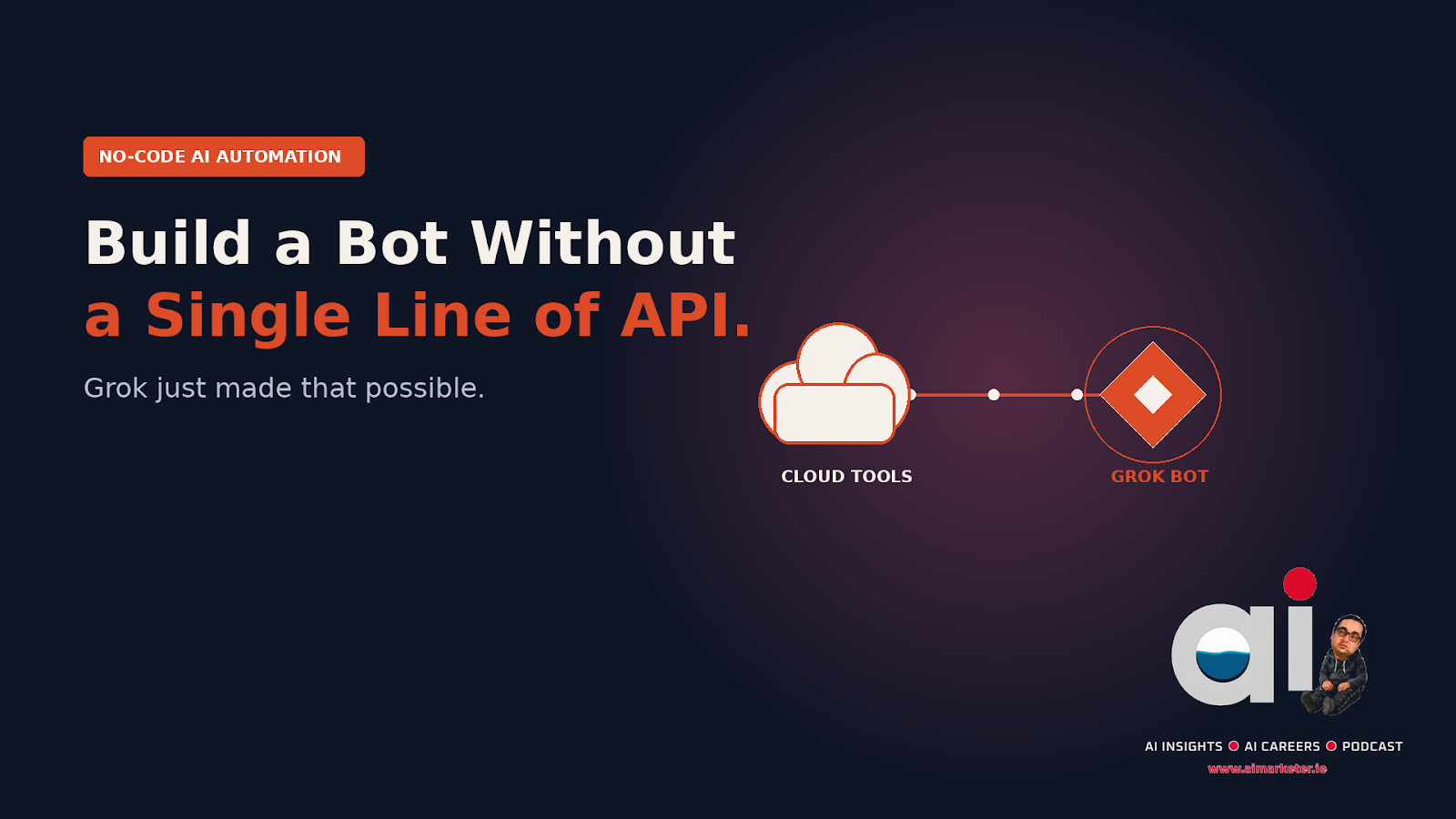
Build a Bot Without a Single Line of API Code. Grok Just Made That Possible.
Tauseef Sarwar••5 min read
"xAI just launched Grok Bot, an AI teammate that logs into your software without any API integration. Here's what makes it unique, and the security detail you should know before adopting it."
For years, building an AI automation meant developers, API keys, and weeks of integration work just to connect one tool to another. Grok Bot, launched by xAI on August 11, 2026, throws that entire process out the window.
It logs into any browser-based software the exact same way a human would, using saved credentials rather than custom-built API connections. No developer required. No integration backlog. Just a bot that opens your tools and gets to work.
This single design choice is what makes Grok Bot one of the more interesting product launches in the AI automation space this year, and it deserves a closer look.
What Grok Bot Actually Is
Grok Bot is not the familiar Grok chatbot most people already know. It is a distinct product built around persistent, named AI agents, referred to simply as "Bots," that live on a cloud computer tied to your account and can be handed real, ongoing work. xAI describes it plainly as "AI teammates you can give real work to," positioning it less as a conversational assistant and more as a virtual employee capable of completing multi-step tasks with minimal supervision.
The launch runs on Grok 4.6, xAI's newest flagship model, which powers the reasoning and task-execution capabilities behind every Bot created on the platform. This puts xAI squarely in competition with Anthropic and OpenAI, both of which have been racing to build similar autonomous agent products throughout 2026.
What Makes It Genuinely Different
Several design choices separate Grok Bot from the typical automation tools flooding the market right now.
No API integration required. Bots sign into browser-based software using saved logins, meaning businesses can automate work across tools that were never designed with automation in mind, without writing a single integration script.
Always-on, persistent operation. A Bot keeps working after you close your laptop, running tasks overnight or throughout the day, and only returns control to you when a decision genuinely requires human judgment.
Learn by watching. Instead of manually configuring rules or writing scripts, you can have a Bot observe you complete a task once, recorded for up to ten minutes without audio, and it converts that observation into a draft skill you can review and test before deploying it for real.
Bots that talk to each other. Multiple Bots can retain memory from earlier tasks and share context, allowing a team-like division of labor where different agents handle different pieces of a larger workflow.
Works across your devices. The beta is available on macOS, Windows, Linux, and iOS, so it is not locked into a single operating system or ecosystem.
How It Fits Into the Bigger Grok Picture
Grok Bot builds on strengths the wider Grok model family has already established. Grok's core models train on and retrieve from the public X firehose, giving them a structural advantage in handling recent events, trending topics, and internet-native language that models trained only on static web crawls tend to miss. This is paired with DeepSearch, a feature that blends AI reasoning with live web scanning to produce structured research output rather than a simple list of links.
Grok has also built a reputation for a looser, more opinionated personality than its competitors, along with advanced reasoning modes for harder problems. Grok Bot inherits this foundation but shifts the value proposition away from smarter conversation and toward autonomous task completion, aligning it with where the broader AI industry is heading in 2026: agents that do not just answer questions but actually finish jobs.
Who Can Access It, and What It Costs
Access at launch is deliberately narrow and tied to premium subscription tiers rather than being broadly available to everyone. Individual users can access Grok Bot through SuperGrok Heavy at 300 US dollars per month.
Cursor Ultra subscribers get access at 200 US dollars per month, bundled together with Cursor's coding environment and frontier model access. A separate Cursor Teams Premium tier is priced at 120 US dollars per seat per month for organizational use, though enterprise customers currently need to join a waitlist, with rollout described as gradual and varying by organization.
The Detail Worth Reading Twice
One aspect of Grok Bot's architecture deserves particular attention before anyone rushes to plug it into sensitive workflows. The product's own launch page states that "Bots have their own computer." xAI's technical documentation, published the very same day, says something different: every Bot created under a single account actually shares one persistent cloud computer, one set of browser sessions, and one shared pool of credentials.
This is not a small discrepancy. xAI's own documentation goes as far as warning that separate Bots should never be treated as a security boundary, meaning a compromise or misuse involving one Bot could potentially expose every other Bot and credential on that same shared machine.
One tech outlet described this setup as creating "a real blast radius." Anyone considering Grok Bot for business use, especially in workflows involving passwords, financial systems, or sensitive client data, should weigh this carefully before adoption.
Why This Launch Matters Right Now
Grok Bot's arrival reflects a clear direction the AI industry is moving in throughout 2026: away from single-turn chatbot interactions and toward autonomous, persistent agents that complete entire workflows with limited human oversight. The "watch me do it once" skill-learning approach is especially notable because it lowers the technical barrier for non-developers to build custom automations, something that has traditionally required scripting knowledge or complex integration work.
At the same time, the gap between xAI's marketing language and its own security documentation is a useful reminder that agentic AI tools, however impressive on the surface, are still maturing quickly and may carry real operational risks that businesses need to evaluate carefully before wide deployment.
For anyone tracking the AI automation space closely, Grok Bot captures both the genuine promise and the growing pains of this next wave of AI teammate products entering the market.
This topic was researched using Perplexity AI and verified by the owner of this article.
How many hours does your business lose every week to work that could be automated?Repeated customer enquiries. Lead follow-ups. Research. Reporting. Data handling. Routine administration.
AIMarketer.ie helps businesses turn repetitive workflows into practical AI-assisted automation designed around the business, with human oversight where it matters. The objective is simple: less repetitive work, more time for customers and growth. Have a workflow you think AI could improve? Visit https://aimarketer.ie/ai-automation
#AIAutomation #ArtificialIntelligence #BusinessAutomation
Author tools
Join the discussion
Add a thoughtful response or a question. Every contribution is reviewed before publication.
Be the first to start the conversation.