
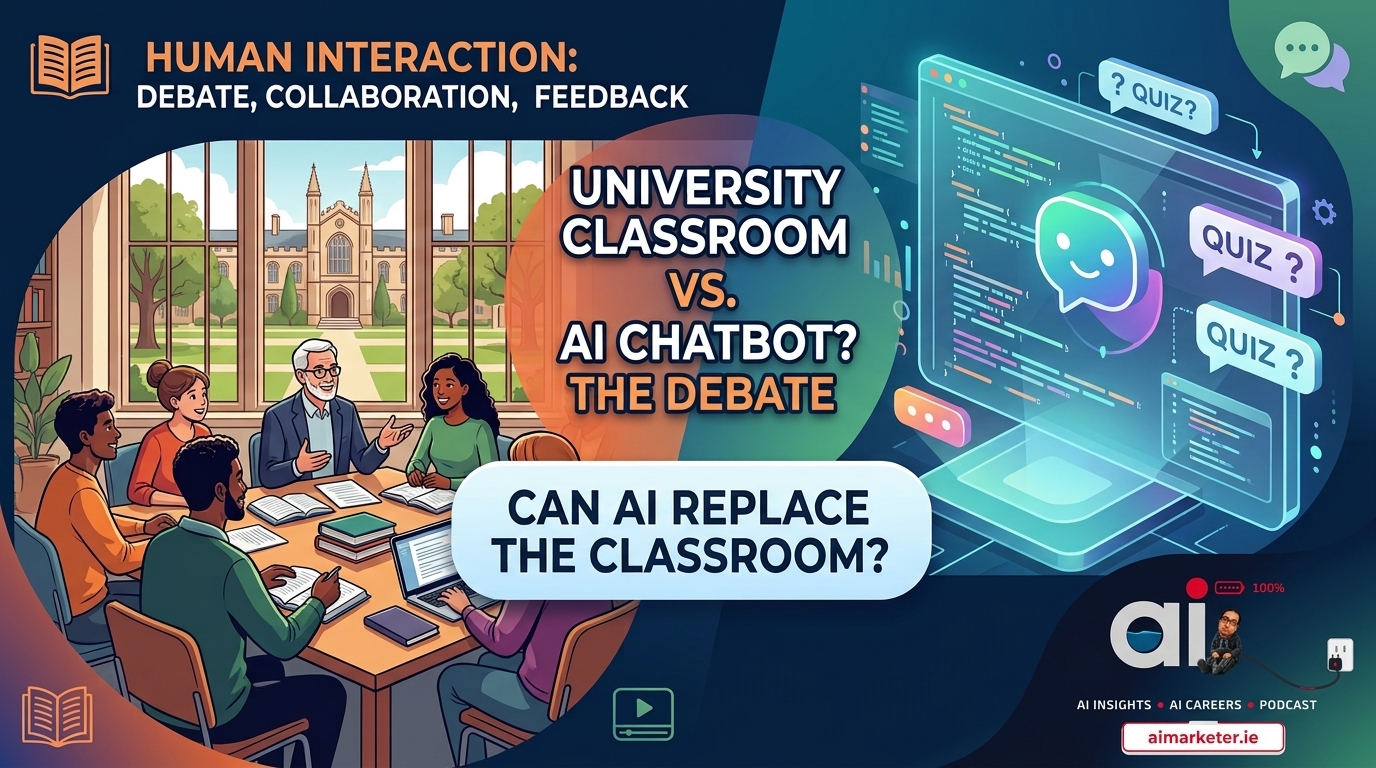
Macquarie University has introduced an AI chatbot into two compulsory psychology subjects while making human tutorials optional. The experiment raises difficult questions about the value of teaching, student choice, and the future of education.
Can an AI chatbot replace a university classroom? If you paid thousands of pounds for a university course, would you accept a chatbot instead of a classroom?
That is the question now being debated after Macquarie University in Sydney introduced an artificial intelligence chatbot into two compulsory psychology subjects. The university has replaced in-person classes with online learning activities supported by a tool called Virtual Peer. Human tutorials are still available, but attendance is optional.
Macquarie says Virtual Peer is designed to support educators, not replace them. Critics argue that removing required face-to-face teaching risks reducing education to a series of readings, quizzes, videos, and automated conversations.
The debate matters far beyond Australia. Universities in the United Kingdom, Ireland, and many other countries are testing AI tutors, study assistants, and personalised learning platforms. The central question is no longer whether AI will enter education. It is whether institutions will use it to improve teaching or to substitute for human contact.
What has Macquarie University changed? Macquarie’s Virtual Peer is used in two mandatory psychology units. It asks students questions and guides them through scenario-based exercises linked to their course content. The university says professors upload and check the material used by the system, making it more focused than a general-purpose chatbot.
The AI activities are described as supplementary. However, neither the AI exercises nor the core online activities are mandatory. Students are assessed through separate research tasks and exams, while live tutorials are available through optional Zoom sessions.
The scale is significant. One introductory subject has six tutorial sessions for 400 students. A final-year subject has 10 sessions for 700 students. That works out at roughly one live class for every 70 students. The Guardian’s report provides the details of the course structure and staff concerns.
Macquarie says Virtual Peer answered close to 80,000 student questions during 2025 and nearly as many in the first half of 2026. Most of those questions were administrative, but the figure shows how quickly students are becoming accustomed to AI support.
Why would a university use an AI tutor? There are reasonable arguments in favour of the experiment.
An AI tool can answer routine questions at any hour. It can repeat an explanation without becoming impatient. It can give students practice questions, introduce scenarios, and help them review basic concepts before an assessment.
For students who work, commute, care for family members, or live far from campus, flexible online support may be valuable. A course-specific chatbot may also be safer than asking students to rely on a general AI system that could provide inaccurate or unrelated information.
AI could be particularly helpful for revision. A student might ask for a simpler explanation of a difficult theory, request a practice scenario, or test their understanding through a short question-and-answer session.
Used in this way, AI is similar to a study guide. It can provide additional practice without claiming to be a lecturer, tutor, or counsellor.
What might students lose? The concern is that education is not only the transfer of information.
A classroom gives students the chance to ask questions that they may not think to type into a chatbot. It allows a teacher to notice confusion, hesitation, or a misunderstanding in real time. Discussion also helps students learn how to explain an idea, listen to another viewpoint, and respond when the answer is not obvious.
Those experiences are especially important in psychology. Students are not only memorising definitions. They are learning how to interpret behaviour, evaluate evidence, discuss sensitive topics, and understand different perspectives.
An AI chatbot may simulate a conversation, but simulation is not the same as a relationship with a teacher or a group of peers. Students may also be less likely to challenge an automated explanation, particularly when the system presents its answer confidently.
One Macquarie student told The Guardian they felt “short-changed” by the change and worried that they were helping to teach a machine how to replace teachers. That reaction captures the emotional side of the debate. Students are not simply buying access to information. They are also paying for expertise, feedback, community, and a recognised learning experience.
Is this about better learning or lower costs? Macquarie says the chatbot supports teachers and that the move is not designed to replace them. That distinction should be tested with evidence rather than accepted as a slogan.
Universities should publish clear measures showing whether AI-supported courses improve learning outcomes, student satisfaction, retention, and access to human support. They should also explain how the quality of the AI content is checked and what happens when the system gives an incorrect answer.
The cost question cannot be ignored. The reported price of an individual psychology subject for an Australian student with a Commonwealth-supported place is AUD $2,174, while a three-year undergraduate degree can cost more than AUD $50,000. If students are paying university-level fees, they deserve a clear explanation of what teaching and support they will receive.
The issue is not whether AI can answer questions. It clearly can. The issue is whether answering questions is enough to justify replacing a required class.
What should schools and universities learn? The safest approach is to use AI to extend teaching, not quietly remove it.
That means keeping human teachers responsible for explanations, assessment, pastoral support, and difficult conversations. It means making the role of the AI system clear to students and giving them a reliable route to human help.
Institutions should also consider several safeguards:
Explain exactly what the AI tool can and cannot do. Make human support easy to access, not merely technically available. Check AI answers against course materials and expert review. Protect student conversations and explain who can monitor them. Test the system with students who have different communication needs. Measure whether students are learning more, not simply asking more questions. Give students meaningful choices when online and in-person formats are offered. Macquarie says in-person classes will return in alternate semesters from 2027, allowing students to choose the format that suits their circumstances. That flexibility may become a useful model, provided choice is real and students are not pushed towards the cheaper option by timetable or cost pressures.
Can AI replace a university classroom? Not by itself.
AI can explain, quiz, summarise, and provide practice. It cannot yet replace the full value of a classroom, where learning includes human judgement, conversation, encouragement, challenge, and shared experience.
The most useful question is not, “Can a chatbot teach this topic?” It is, “Which parts of learning are improved by AI, and which parts become weaker when human contact is removed?”
Universities should answer that question openly before changing the experience students are paying for.
For students, the advice is simple: use AI as a study partner, but do not confuse quick answers with a complete education. The strongest learning still comes from checking ideas, asking difficult questions, discussing them with other people, and receiving feedback from someone who understands your progress.
If a university replaces a classroom with a chatbot, it must prove that students are gaining more than convenience. They must still be gaining an education.
#EducationAI #FutureOfLearning #AIinEducation
Author tools
Join the discussion
Comments
Add a thoughtful response or a question. Every contribution is reviewed before publication.
Be the first to start the conversation.