AI Market Trends
France challenges Google's AI search. What it means for your traffic in Ireland and the UK
Safina Naz••7 min read
France challenges Google's AI search. What it means for your traffic in Ireland and the UK
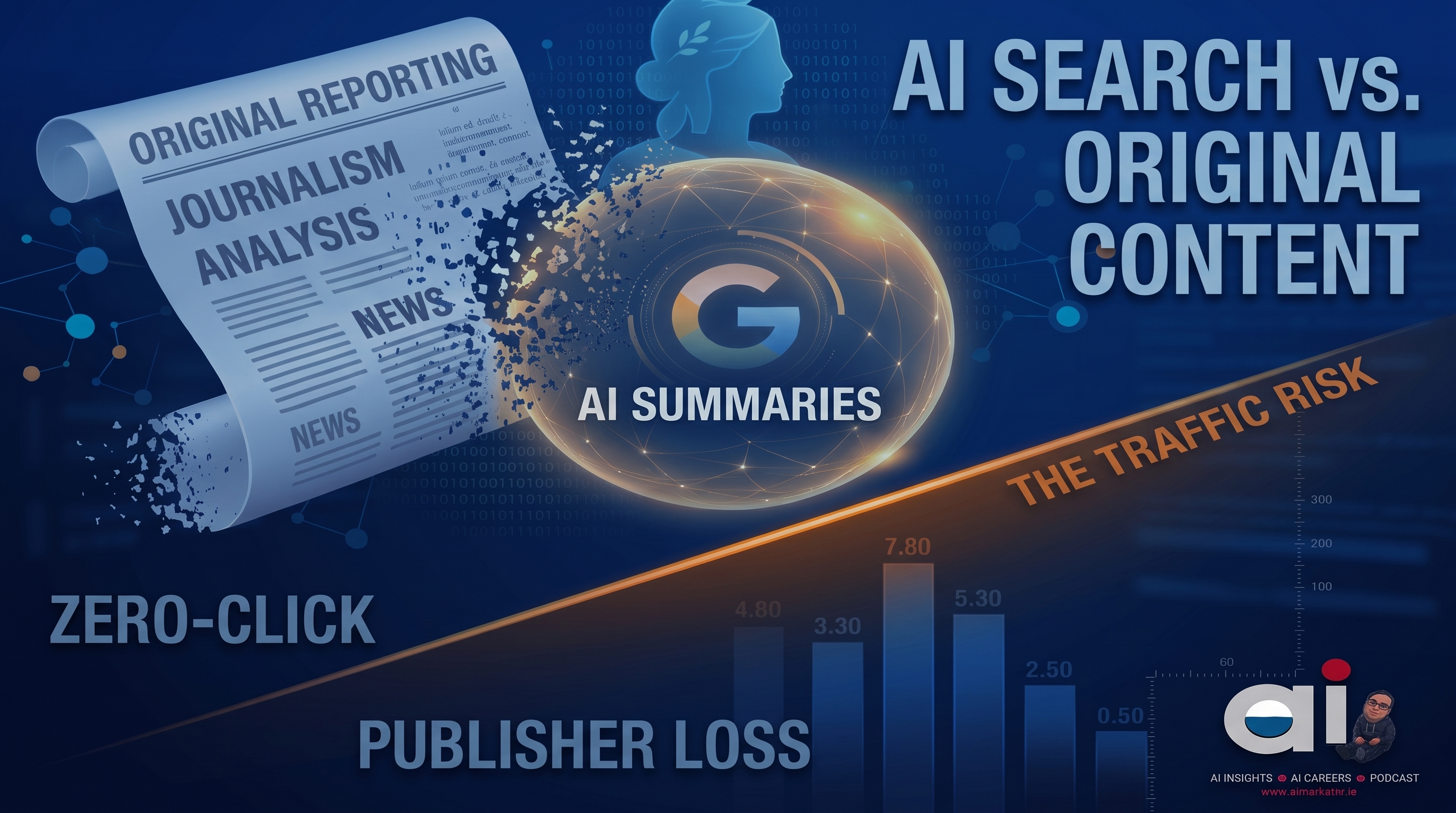
French publishers have taken Google's AI summaries to the regulator. Some headlines call it a lawsuit over lost website visits. That framing is too simple. The accurate position is a competition complaint about press content, the design of AI search, and the loss of click through traffic. It is a serious dispute. It is not yet a final ruling that proves Google caused a set decline for every publisher.
Google switched on AI Overviews and AI Mode in France on 22 July 2026. AI Overviews place a generated answer above the usual links. AI Mode runs a conversational search with follow up questions.
For a reader, the answer arrives faster. For a publisher, the economics change. A reader who visits your site can see an ad, subscribe, join a newsletter, or return. A reader who gets the answer inside Google may never build that relationship.
France was one of the last major Western markets to get these features. Google delayed the launch because of a long fight with French publishers over neighbouring rights, the law that requires platforms to pay for reusing news content.
This distinction matters, and responsible coverage should hold it.
APIG, the Alliance de la presse d'information générale, referred Google to the Autorité de la concurrence on 11 August 2026. APIG represents around 300 French daily newspapers. Its president is Marc Feuillée, chief executive of Le Figaro.
APIG argues that Google's 2022 commitments require a separate negotiation for any new service, and that Google launched AI Overviews and AI Mode without opening one. The magazine publishers' body, the SEPM, also criticised the launch and the lack of consultation.
A referral can lead to an investigation, requests for information, negotiations, commitments, or further action. It does not prove that Google broke competition law. Use the words challenge, complaint, referral, and allegation, not won.
Traditional search set a clear exchange. You created the content. Google indexed it and showed a result. The reader clicked through to your article.
AI search changes that exchange. Google can pull from several sources to build one answer. The links may still show, but the reader often feels the task is done before visiting anyone. Publishers fear a zero click market, where you still pay journalists, editors, and photographers, and Google uses the output to answer the question. The value moves to the search layer. The cost stays with you.
Read the figures with care.
Arcom, France's media and digital regulator, estimates a 33 to 38 percent traffic loss attributable to AI summaries. APIG cites this range in its complaint.
Chartbeat data in the Reuters Institute 2026 report shows Google organic search traffic to more than 2,500 news sites fell 33 percent globally, and 38 percent in the United States, between November 2024 and November 2025. Google Discover referrals fell 21 percent over the same window.
The Reuters Institute is direct about the limit of this data. It states it cannot yet prove how much of that fall is down to AI Overviews. Search traffic also moves with ranking changes, news cycles, seasonality, social referrals, and changes publishers make themselves. The traffic risk is credible. The exact cause is still hard to isolate.
Google presents a different view. It says AI Overviews and AI Mode help users explore the web, provide direct links, surface more sources, and support deeper searches. It says search keeps growing and that people who use AI features ask more complex questions.
On the French complaint, Google told Franceinfo it had reviewed its payment system to account for protected content shown inside AI Overviews and AI Mode, and that publishers can choose whether to appear in the AI features without losing standard search placement. Google has neighbouring rights deals with 450 French publishers.
Both effects can be true in different cases. A simple factual query may produce no click. A detailed comparison or investigation may still bring a later visit. The problem for publishers is measurement, not slogans.
France has a long record of conflict with Google over press content. The Autorité de la concurrence fined Google €500 million in 2021 and a further €250 million in March 2024 in the same neighbouring rights dispute.
That history gives the AI complaint a wider frame. The questions are not only whether a summary appears on a page. They include:
- Did Google use the content on a proper legal or commercial basis? - Did publishers get a real choice before the features launched? - Can a publisher leave AI summaries without losing classic search visibility? - Does Google's dominant position make consent weaker? - Are AI summaries a new product rather than a normal search result?
Two other disputes are easy to merge with the AI complaint.
In June 2026 the Paris Tribunal des activités économiques ordered Google to pay about €107 million to Prisma Media, Le Figaro, and Les Echos-Le Parisien. That case concerned anti competitive practices in online advertising, not AI Overviews. Across four parties, including Dailymotion, the total reached €126 million. Google has contested the decisions.
A separate case involves Brave. APIG and 53 French publishers sued Brave in the Paris judicial court over the use of press content across its AI search and generative systems, plus trademark claims. The first hearing is set for 10 September 2026. That is a court lawsuit against Brave, not Google.
There is also a Brussels track. The European Commission opened a formal antitrust investigation into Google's AI content practices on 9 December 2025.
The platform relationship here is the same. Many publishers depend on search for advertising, subscriptions, and audience growth. If AI summaries cut clicks, you need to rethink which stories chase search traffic and which build direct loyalty.
The UK moved first. The Competition and Markets Authority forced Google to let publishers refuse AI features while staying indexed, from 3 June 2026, under the Digital Markets, Competition and Consumers Act. Page level controls follow in March 2027.
Irish publishers face a sharper version of the problem. Many run at smaller scale, with fewer resources to measure AI visibility, negotiate with platforms, or build alternative channels.
The practical questions are immediate:
- How much of your traffic comes from simple informational searches? - Which articles create subscriptions, registrations, or repeat visits? - Can you measure AI visibility apart from ordinary search? - Does leaving AI features cost you classic search visibility? - Which direct channels reduce your dependence on Google?
Collect evidence before you judge. Track organic clicks, impressions, brand searches, direct visits, newsletter sign ups, subscriptions, returning users, and referrals from search features. Compare the period before and after AI features appear in each market. Separate AI effects from ranking updates, seasonality, big news events, and site changes.
Identify your exposed content. Simple question and answer pages are easy for AI summaries to absorb. Original reporting, local expertise, exclusive data, and strong analysis give a reader a reason to visit the source.
Build direct audience development now. Newsletters, memberships, podcasts, events, apps, and registered user services reduce platform dependence. They do not replace search. They give you control over the relationship.
French publishers are not objecting to a new interface. They are challenging the economics of AI search. The core question is whether a platform can use journalism to answer queries, keep users inside its own environment, and still call the relationship a normal search referral.
The complaint is significant. It is not yet a final ruling that proves a measured loss for every publisher. It is the next stage in a wider conflict over competition law, neighbouring rights, copyright, platform power, and how journalism gets funded.
The lesson for Ireland and the UK is immediate. Do not measure success only by whether your page appears in an AI answer. Measure whether the reader reaches you, returns to you, subscribes to you, and understands why your original work deserves a direct visit.
AI research disclosure. This article was researched with AI assistance and checked against the cited European, French, and UK sources. It is general information, not legal advice or a prediction of any investigation or court outcome.
AIMarketer covers AI, digital marketing, current affairs, recruitment, machine learning, software engineering, and the changing relationship between technology and the media. Visit aimarketer.ie for further analysis.
#AISearch #GEO #MarketingIreland #DigitalPublishing
Author tools
Join the discussion
Add a thoughtful response or a question. Every contribution is reviewed before publication.
Be the first to start the conversation.