AI Market Trends
Meta's Open-Source Comeback: What Muse Glimmer Really Means for the Industry
Tauseef Sarwar••14 min read

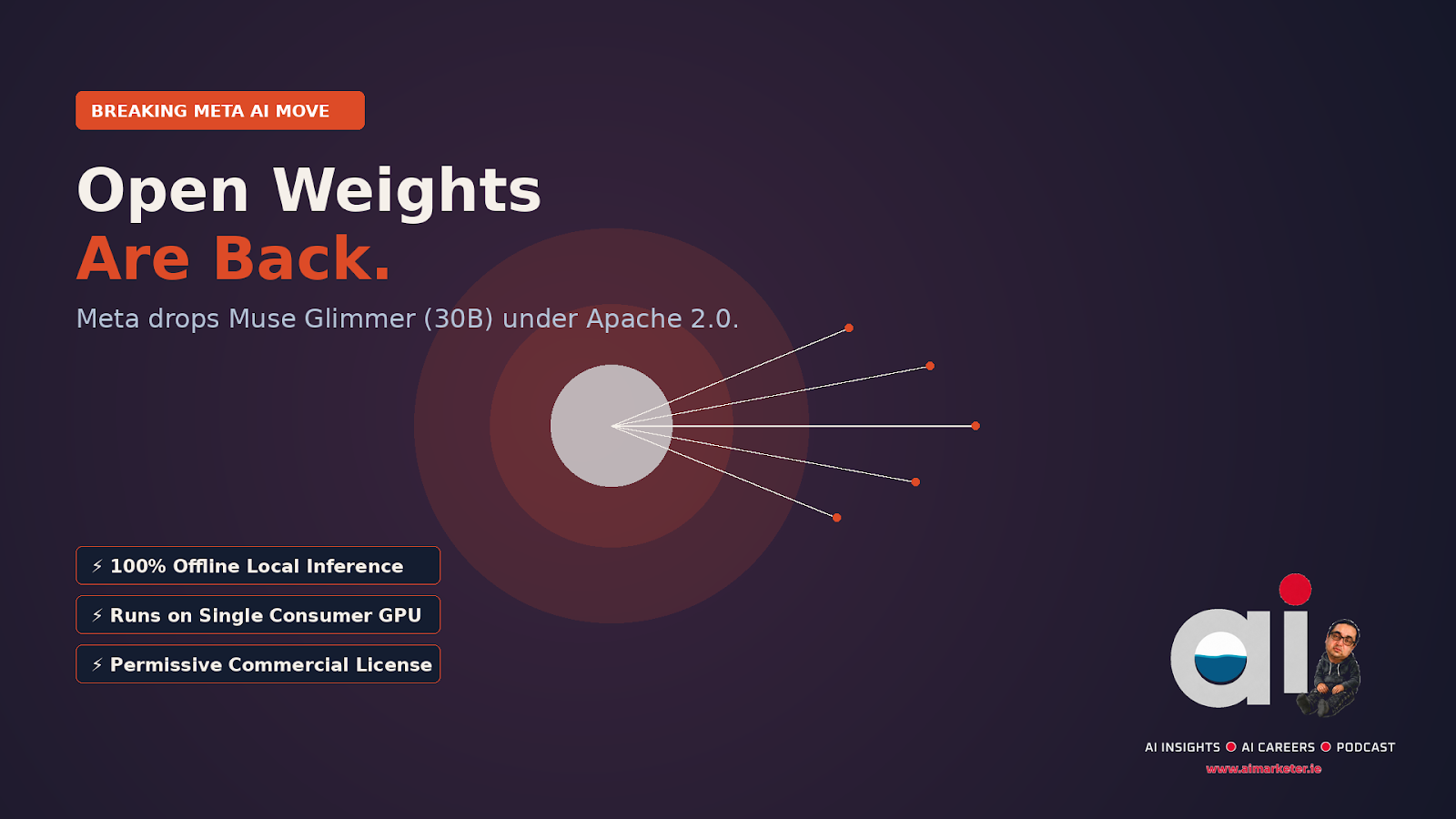
"Meta just reversed course on open-source AI, releasing Muse Glimmer, a 30-billion-parameter model under Apache 2.0. Here's what it means for developers, businesses, and the future of local AI."
Meta just made a move that caught the entire AI community off guard. After appearing to step away from open-source AI development earlier this year, the company has returned to open weights with a new 30-billion-parameter model called Muse Glimmer, released on August 10, 2026. This isn't a rebrand of Llama, and it isn't a minor update either. It's a distinct, deliberate strategic pivot that says a lot about where the open-weight AI race is heading.
Setting the Scene: Why This Release Is Surprising Back in April 2026, Meta quietly shelved its Llama model line, the open-weight family that had made the company a symbol of open AI development since 2023. In its place, Meta introduced Muse Spark, a closed, proprietary model that only Meta itself could access and monetize. For the open-source community, this felt like the end of an era. Developers who had built tools, fine-tuned models, and entire businesses around Llama's openness were left wondering whether Meta had permanently closed that door.
Then, just five days after launching the closed-weights Muse Spark 1.2 coding model on August 5, Meta reversed course. On August 10, the company released Muse Glimmer under a fully permissive Apache 2.0 license, making the weights freely downloadable on Hugging Face. This kind of rapid reversal, within the same product family and inside a single week, is unusual even by the fast-moving standards of the AI industry.
What Muse Glimmer Actually Is Muse Glimmer is a 30-billion-parameter dense multimodal model, distilled from Meta's larger, still-closed Muse Spark system. It includes a text decoder of roughly 28 billion parameters paired with a vision component of about 1.8 to 2 billion parameters, based on a ViT-style perception encoder that can process thousands of visual tokens per image. In simple terms, this is not a small experimental model. It is a serious, full-featured system designed to compete with other leading open-weight releases from companies like DeepSeek and Alibaba's Qwen team.
What makes Muse Glimmer especially notable is its focus on local deployment. Meta engineers compressed the model using four-bit quantization, shrinking its memory footprint from roughly 55 gigabytes down to under 20 gigabytes. That means the model can run entirely on a single consumer-grade GPU or an Apple Mac with unified memory, without needing cloud access, an API key, or a subscription fee.
This is a significant shift because most frontier-scale models still depend on expensive cloud infrastructure. Muse Glimmer's positioning is squarely aimed at developers who want to build local AI agents, coding assistants, and automation tools that work offline and privately.
The License Advantage One of the most important details in this release is the licensing structure. Muse Glimmer ships under the Apache 2.0 license, which is one of the most permissive software licenses. It allows unrestricted commercial use, modification, and redistribution, with no usage conditions beyond the license terms itself.
This is notably different from Llama 4, which carried a Meta-specific community license that excluded companies operating in the European Union above a certain size, and imposed other usage restrictions. Muse Glimmer removes that friction entirely, making it immediately usable across the EU and other regions without legal complications.
Early integration support has already begun appearing across popular local inference tools including Llama.cpp, Ollama, LM Studio, and Unsloth, with further optimized versions expected to roll out over the following weeks. This kind of rapid ecosystem adoption tends to happen only when a model release generates genuine developer excitement, which further reinforces how meaningful this launch is.
Performance and Benchmarks According to Meta's own reporting, Muse Glimmer performs strongly for its size class, achieving competitive scores on benchmarks like MCP Atlas, SWE-Bench Pro, and AIME 2026 reasoning tests. It reportedly leads its size category on tool-use and multi-step reasoning evaluations, although it trails some competing models like Qwen's latest release on certain coding and terminal-based benchmarks.
The model also ships with a speculative decoding technique called DFlash, which Meta claims delivers up to three times faster generation speeds on high-end consumer GPUs like the RTX 5090, and nearly double the speed on Apple's latest silicon chips.
Why This Matters Beyond the Technical Specs The real story here isn't just a new model release. It's what this reversal signals about Meta's broader AI strategy and the state of the open-weight AI market as a whole. Meta shutting down Llama and introducing a closed model suggested the company might be following the path of competitors like OpenAI and Anthropic, who keep their most capable models fully proprietary.
The sudden return to open weights, even if only for a distilled, smaller model, suggests internal debate within Meta about the right balance between openness and competitive advantage.
Meta's own leadership has hinted that more could be coming. Alexandr Wang, who now leads Meta's Superintelligence Labs, publicly committed to eventually releasing an open-weight version of the larger Muse Spark model as well. If that happens, it would represent an even bigger shift, essentially bringing Meta's flagship capability back into open-source territory after months of exclusivity.
What This Means for Businesses and Developers For companies and developers building AI products, this release matters because it lowers the barrier to running capable AI models without dependency on a single cloud provider or paying per-token fees. Local, on-device AI has been a growing trend throughout 2026, driven by concerns around data privacy, latency, and operating costs.
Muse Glimmer positions itself directly at the center of that trend, offering a model that is genuinely useful for real-world agent workflows while remaining light enough to run on hardware people already own.
This story is worth watching closely over the coming weeks, especially as more benchmarks, community fine-tunes, and real-world deployments start to emerge.
Whether this marks a lasting return to open-source values at Meta, or simply a calculated move to stay competitive against rivals like DeepSeek and Qwen, remains an open question. But for now, the open-weight AI race clearly isn't settled, and Meta has just made its next move.Meta just made a move that caught the entire AI community off guard. After appearing to step away from open-source AI development earlier this year, the company has returned to open weights with a new 30-billion-parameter model called Muse Glimmer, released on August 10, 2026. This isn't a rebrand of Llama, and it isn't a minor update either. It's a distinct, deliberate strategic pivot that says a lot about where the open-weight AI race is heading.
Setting the Scene: Why This Release Is Surprising Back in April 2026, Meta quietly shelved its Llama model line, the open-weight family that had made the company a symbol of open AI development since 2023. In its place, Meta introduced Muse Spark, a closed, proprietary model that only Meta itself could access and monetize. For the open-source community, this felt like the end of an era. Developers who had built tools, fine-tuned models, and entire businesses around Llama's openness were left wondering whether Meta had permanently closed that door.
Then, just five days after launching the closed-weights Muse Spark 1.2 coding model on August 5, Meta reversed course. On August 10, the company released Muse Glimmer under a fully permissive Apache 2.0 license, making the weights freely downloadable on Hugging Face. This kind of rapid reversal, within the same product family and inside a single week, is unusual even by the fast-moving standards of the AI industry.
What Muse Glimmer Actually Is Muse Glimmer is a 30-billion-parameter dense multimodal model, distilled from Meta's larger, still-closed Muse Spark system. It includes a text decoder of roughly 28 billion parameters paired with a vision component of about 1.8 to 2 billion parameters, based on a ViT-style perception encoder that can process thousands of visual tokens per image. In simple terms, this is not a small experimental model. It is a serious, full-featured system designed to compete with other leading open-weight releases from companies like DeepSeek and Alibaba's Qwen team.
What makes Muse Glimmer especially notable is its focus on local deployment. Meta engineers compressed the model using four-bit quantization, shrinking its memory footprint from roughly 55 gigabytes down to under 20 gigabytes. That means the model can run entirely on a single consumer-grade GPU or an Apple Mac with unified memory, without needing cloud access, an API key, or a subscription fee.
This is a significant shift because most frontier-scale models still depend on expensive cloud infrastructure. Muse Glimmer's positioning is squarely aimed at developers who want to build local AI agents, coding assistants, and automation tools that work offline and privately.
The License Advantage One of the most important details in this release is the licensing structure. Muse Glimmer ships under the Apache 2.0 license, which is one of the most permissive software licenses. It allows unrestricted commercial use, modification, and redistribution, with no usage conditions beyond the license terms itself.
This is notably different from Llama 4, which carried a Meta-specific community license that excluded companies operating in the European Union above a certain size, and imposed other usage restrictions. Muse Glimmer removes that friction entirely, making it immediately usable across the EU and other regions without legal complications.
Early integration support has already begun appearing across popular local inference tools including Llama.cpp, Ollama, LM Studio, and Unsloth, with further optimized versions expected to roll out over the following weeks. This kind of rapid ecosystem adoption tends to happen only when a model release generates genuine developer excitement, which further reinforces how meaningful this launch is.
Performance and Benchmarks According to Meta's own reporting, Muse Glimmer performs strongly for its size class, achieving competitive scores on benchmarks like MCP Atlas, SWE-Bench Pro, and AIME 2026 reasoning tests. It reportedly leads its size category on tool-use and multi-step reasoning evaluations, although it trails some competing models like Qwen's latest release on certain coding and terminal-based benchmarks.
The model also ships with a speculative decoding technique called DFlash, which Meta claims delivers up to three times faster generation speeds on high-end consumer GPUs like the RTX 5090, and nearly double the speed on Apple's latest silicon chips.
Why This Matters Beyond the Technical Specs The real story here isn't just a new model release. It's what this reversal signals about Meta's broader AI strategy and the state of the open-weight AI market as a whole. Meta shutting down Llama and introducing a closed model suggested the company might be following the path of competitors like OpenAI and Anthropic, who keep their most capable models fully proprietary.
The sudden return to open weights, even if only for a distilled, smaller model, suggests internal debate within Meta about the right balance between openness and competitive advantage.
Meta's own leadership has hinted that more could be coming. Alexandr Wang, who now leads Meta's Superintelligence Labs, publicly committed to eventually releasing an open-weight version of the larger Muse Spark model as well. If that happens, it would represent an even bigger shift, essentially bringing Meta's flagship capability back into open-source territory after months of exclusivity.
What This Means for Businesses and Developers For companies and developers building AI products, this release matters because it lowers the barrier to running capable AI models without dependency on a single cloud provider or paying per-token fees. Local, on-device AI has been a growing trend throughout 2026, driven by concerns around data privacy, latency, and operating costs.
Muse Glimmer positions itself directly at the center of that trend, offering a model that is genuinely useful for real-world agent workflows while remaining light enough to run on hardware people already own.
This story is worth watching closely over the coming weeks, especially as more benchmarks, community fine-tunes, and real-world deployments start to emerge.
Whether this marks a lasting return to open-source values at Meta, or simply a calculated move to stay competitive against rivals like DeepSeek and Qwen, remains an open question. But for now, the open-weight AI race clearly isn't settled, and Meta has just made its next move.
Meta just made a move that caught the entire AI community off guard. After appearing to step away from open-source AI development earlier this year, the company has returned to open weights with a new 30-billion-parameter model called Muse Glimmer, released on August 10, 2026. This isn't a rebrand of Llama, and it isn't a minor update either. It's a distinct, deliberate strategic pivot that says a lot about where the open-weight AI race is heading.
Setting the Scene: Why This Release Is Surprising Back in April 2026, Meta quietly shelved its Llama model line, the open-weight family that had made the company a symbol of open AI development since 2023. In its place, Meta introduced Muse Spark, a closed, proprietary model that only Meta itself could access and monetize. For the open-source community, this felt like the end of an era. Developers who had built tools, fine-tuned models, and entire businesses around Llama's openness were left wondering whether Meta had permanently closed that door.
Then, just five days after launching the closed-weights Muse Spark 1.2 coding model on August 5, Meta reversed course. On August 10, the company released Muse Glimmer under a fully permissive Apache 2.0 license, making the weights freely downloadable on Hugging Face. This kind of rapid reversal, within the same product family and inside a single week, is unusual even by the fast-moving standards of the AI industry.
What Muse Glimmer Actually Is Muse Glimmer is a 30-billion-parameter dense multimodal model, distilled from Meta's larger, still-closed Muse Spark system. It includes a text decoder of roughly 28 billion parameters paired with a vision component of about 1.8 to 2 billion parameters, based on a ViT-style perception encoder that can process thousands of visual tokens per image. In simple terms, this is not a small experimental model. It is a serious, full-featured system designed to compete with other leading open-weight releases from companies like DeepSeek and Alibaba's Qwen team.
What makes Muse Glimmer especially notable is its focus on local deployment. Meta engineers compressed the model using four-bit quantization, shrinking its memory footprint from roughly 55 gigabytes down to under 20 gigabytes. That means the model can run entirely on a single consumer-grade GPU or an Apple Mac with unified memory, without needing cloud access, an API key, or a subscription fee.
This is a significant shift because most frontier-scale models still depend on expensive cloud infrastructure. Muse Glimmer's positioning is squarely aimed at developers who want to build local AI agents, coding assistants, and automation tools that work offline and privately.
The License Advantage One of the most important details in this release is the licensing structure. Muse Glimmer ships under the Apache 2.0 license, which is one of the most permissive software licenses. It allows unrestricted commercial use, modification, and redistribution, with no usage conditions beyond the license terms itself.
This is notably different from Llama 4, which carried a Meta-specific community license that excluded companies operating in the European Union above a certain size, and imposed other usage restrictions. Muse Glimmer removes that friction entirely, making it immediately usable across the EU and other regions without legal complications.
Early integration support has already begun appearing across popular local inference tools including Llama.cpp, Ollama, LM Studio, and Unsloth, with further optimized versions expected to roll out over the following weeks. This kind of rapid ecosystem adoption tends to happen only when a model release generates genuine developer excitement, which further reinforces how meaningful this launch is.
Performance and Benchmarks According to Meta's own reporting, Muse Glimmer performs strongly for its size class, achieving competitive scores on benchmarks like MCP Atlas, SWE-Bench Pro, and AIME 2026 reasoning tests. It reportedly leads its size category on tool-use and multi-step reasoning evaluations, although it trails some competing models like Qwen's latest release on certain coding and terminal-based benchmarks.
The model also ships with a speculative decoding technique called DFlash, which Meta claims delivers up to three times faster generation speeds on high-end consumer GPUs like the RTX 5090, and nearly double the speed on Apple's latest silicon chips.
Why This Matters Beyond the Technical Specs The real story here isn't just a new model release. It's what this reversal signals about Meta's broader AI strategy and the state of the open-weight AI market as a whole. Meta shutting down Llama and introducing a closed model suggested the company might be following the path of competitors like OpenAI and Anthropic, who keep their most capable models fully proprietary.
The sudden return to open weights, even if only for a distilled, smaller model, suggests internal debate within Meta about the right balance between openness and competitive advantage.
Meta's own leadership has hinted that more could be coming. Alexandr Wang, who now leads Meta's Superintelligence Labs, publicly committed to eventually releasing an open-weight version of the larger Muse Spark model as well. If that happens, it would represent an even bigger shift, essentially bringing Meta's flagship capability back into open-source territory after months of exclusivity.
What This Means for Businesses and Developers For companies and developers building AI products, this release matters because it lowers the barrier to running capable AI models without dependency on a single cloud provider or paying per-token fees. Local, on-device AI has been a growing trend throughout 2026, driven by concerns around data privacy, latency, and operating costs.
Muse Glimmer positions itself directly at the center of that trend, offering a model that is genuinely useful for real-world agent workflows while remaining light enough to run on hardware people already own.
This story is worth watching closely over the coming weeks, especially as more benchmarks, community fine-tunes, and real-world deployments start to emerge.
Whether this marks a lasting return to open-source values at Meta, or simply a calculated move to stay competitive against rivals like DeepSeek and Qwen, remains an open question. But for now, the open-weight AI race clearly isn't settled, and Meta has just made its next move.
This topic was researched using Perplexity AI and verified by the owner of this article.
For AI Automation needs, discuss your project with me. Visit https://aimarketer.ie/ai-automation
Author tools
Join the discussion
Add a thoughtful response or a question. Every contribution is reviewed before publication.
Be the first to start the conversation.