
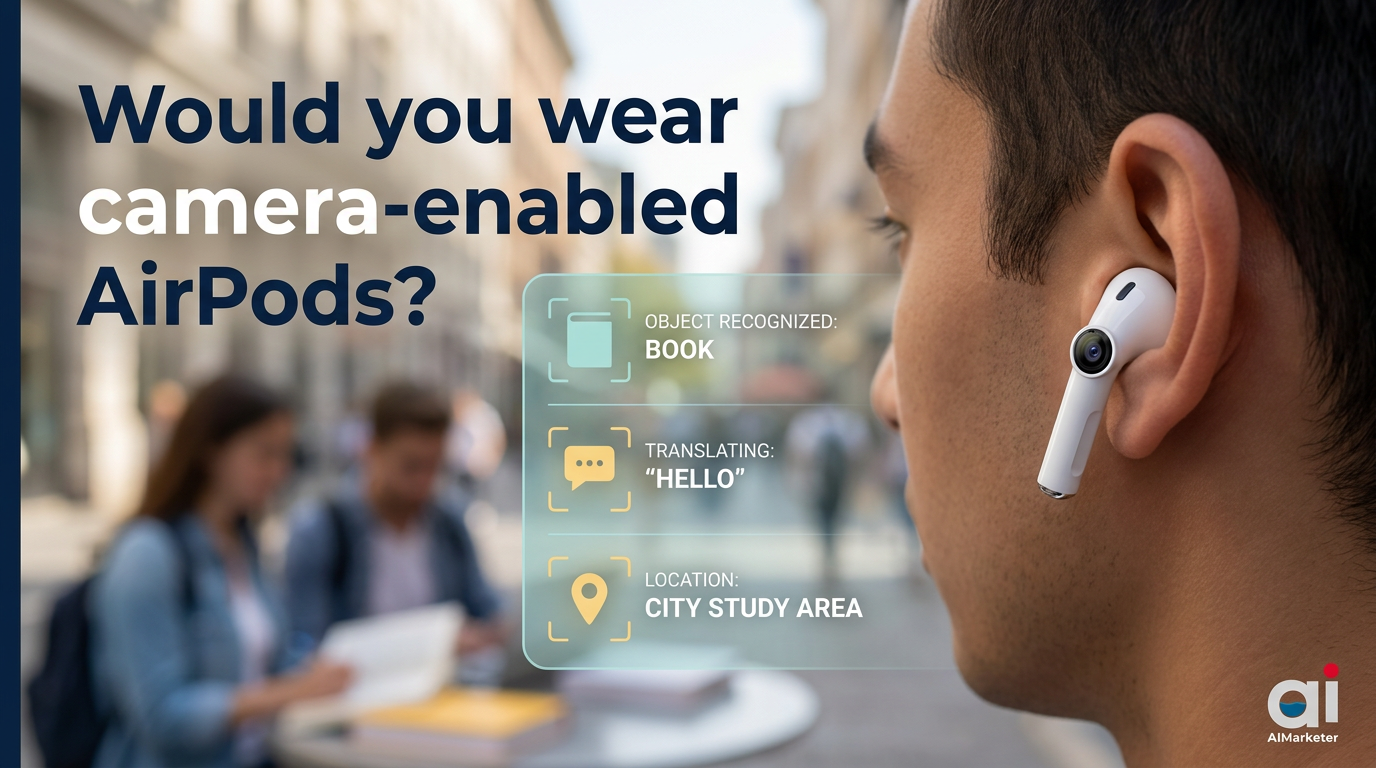
Camera-enabled earbuds could make visual AI more useful and more discreet. Before these devices become normal, users need clear answers about consent, recording, data processing, and control.
**The privacy questions behind wearable AI**
A pair of earbuds that can look at the world for you sounds useful. They could translate a sign, identify an object, read a label, or describe a scene through a quiet voice in your ear.
But the same convenience creates an uncomfortable question: would you wear camera-enabled AirPods if the people around you could not easily tell when they were recording?
Reports have suggested that Apple is exploring cameras and visual intelligence for future AirPods. The details remain unconfirmed, so this should be treated as a developing technology story rather than a confirmed product announcement. However, the underlying idea is no longer science fiction.
Researchers at the University of Washington have already demonstrated VueBuds, wireless earbuds with tiny cameras and visual AI. Their prototype uses low-resolution, black-and-white images, sends them to a nearby device, and allows a user to ask questions about what they can see.
**The technology is moving forward. The social rules around it are still catching up.**
**What could camera-enabled earbuds do?** The most useful applications are not necessarily about constant recording. They are short, specific tasks that help someone understand the world around them.
A student could ask an AI system to read a difficult passage aloud or translate a phrase in another language. A traveller could ask for help with a sign or a menu. Someone with low vision could use visual assistance to identify objects, read text, or navigate a familiar environment.
The University of Washington’s VueBuds research tested tasks including object recognition, translation, and text identification. The system used low-resolution images to reduce power and data demands, while local processing helped keep the images away from the cloud. In the researchers’ tests, the earbuds performed comparably to Ray-Ban Meta glasses across several tasks. The University of Washington explains the prototype and its tests here.
This points to an important distinction. The future of wearable AI may not require an always-on camera streaming everything to a remote server. It could involve occasional images, local processing, and a clear voice command that activates the system only when the wearer asks for help.
Why earbuds could create a bigger privacy problem Smart glasses already raise concerns because a small camera can record people without an obvious conversation or visible phone being held up. Earbuds could make that problem harder to recognise.
A person wearing camera-enabled glasses may appear to be looking through a camera. A person wearing ordinary-looking earbuds may not give anyone the same warning. The camera could be positioned near the side of the user’s face, outside the view of the person being observed.
**That creates several risks.**
First, consent becomes unclear. If an AI system captures an image of you in a café, classroom, office, or public event, did you agree to that? Being in a public place does not necessarily mean you expect your face, voice, or belongings to be analysed by an AI system.
Second, the data may reveal more than the wearer expects. An image can contain faces, documents, computer screens, addresses, school materials, health information, or private conversations. Even a short image can provide context that is sensitive when combined with location and time.
Third, AI interpretation can be wrong. A visual model may misread a sign, identify the wrong object, or describe a person inaccurately. If a user relies on that answer while travelling, studying, or making a decision, a confident mistake can be more dangerous than no answer at all.
Privacy specialists have made similar points about AI wearables more broadly. Data from wearable devices can be connected with location, health information, and behavioural patterns. Syrenis’ overview of AI wearable privacy risks highlights the importance of transparency, consent, data retention, and individual rights.
**Local processing is helpful, but it is not enough**
The VueBuds design offers a useful privacy principle: process information on the user’s device wherever possible. The University of Washington says the prototype processes images locally, uses a recording light, and allows users to delete images immediately.
Those are sensible safeguards. They should become a minimum standard, not a marketing bonus.
Local processing can reduce the risk of sensitive images being uploaded to a company’s servers. It does not, by itself, answer every privacy question. People still need to know when an image is taken, what the AI stores, whether the device keeps a history, and whether future software updates could change those settings.
**A trustworthy wearable AI system should provide:**
- A clear, visible recording indicator that cannot be disabled without an obvious warning. - A physical switch or simple control to disable the camera. - Local processing by default for ordinary visual questions. - Automatic deletion of captured images unless the user chooses to save them. - Plain-language explanations of what data is collected and why. - Strong protections against analysing children, private documents, or people who have not agreed to be recorded. - Reliable answers when the system is uncertain, rather than confident guesses.
**Would I wear them?** Possibly, but only for limited tasks and only if the controls were obvious.
The strongest use cases are those where the wearer actively asks for help, such as translating a sign or reading a label. The weakest use case is continuous background recording that quietly builds a searchable record of other people and places.
That difference matters. Wearable AI should assist the person wearing it without turning everyone nearby into an unwilling source of training data.
Camera-enabled AirPods may eventually become a useful accessibility and learning tool. They may help people interact with information more naturally and reduce the need to look down at a screen. But adoption should depend on more than battery life, accuracy, and design.
It should depend on trust.
*Before buying camera-enabled earbuds, ask three questions: Can I tell when the camera is active? Can people around me tell? And can I prove what happens to the images afterwards?*
If the answer to any of these is unclear, the technology is not ready for everyday use.
**Would you wear camera-enabled AirPods, or would the privacy risk outweigh the convenience?**
Author tools
Join the discussion
Comments
Add a thoughtful response or a question. Every contribution is reviewed before publication.
Be the first to start the conversation.